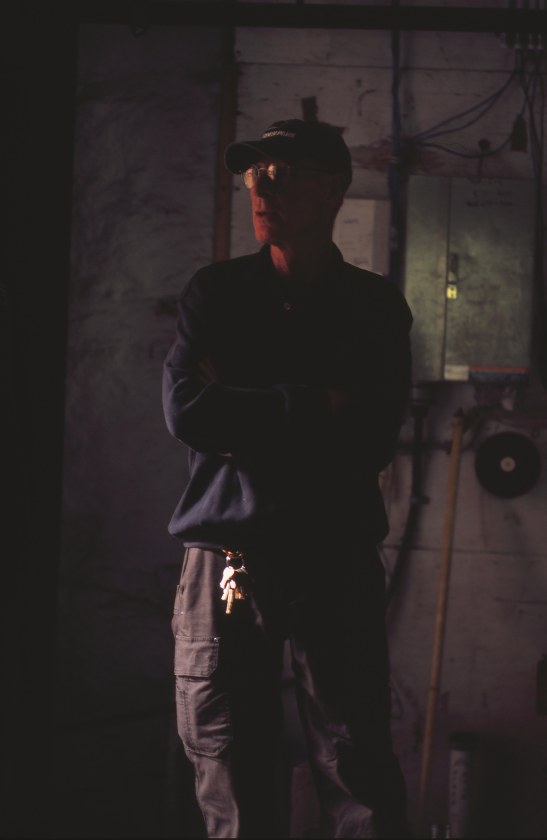
“The walls talk to you- if you can listen,” Fred O’Connor tells us- Edie and me…
…as we three stand inside his shop, looking at (listening to?) the 165 year old granite wall- big, regularly sized blocks of granite, quarried in Marlborough, one town away, hauled here one by one, I imagine, by horse or oxen, uphill, to build the Granite Mill, the piece de resistance– to weather, time and technology- in Historic Harrisville.
The walls talk to you, if you listen.
I hadn’t thought about old buildings that way, much as I love old buildings. Maybe not all of them. But an awful lot of them.
And so what a thrill to discover that Fred- full name, Frederick J. O’Connor- felt the same way. Oh, and full title,
Project Manager, Historic Harrisville
…as I read from his card, now folded over the little camera eye at the top of the screen on my Apple computer, just so if someone hacks into the computer, they can’t also be watching me- through my own computer, without me knowing a thing about it.
Modern times, as someone said in another place, another time. The modern times just keep on happening, whether we like them or not.
So I suppose that the past can be, in some way, some kind of refuge. But it’s also been said- I think by Macauley, a British historian- that a country that doesn’t know its past can’t know its future. -Another way of saying that if you don’t know who you are, you’re probably not going to have much luck in becoming, or continuing to be, the person or country you want to become with the unending passage of time.
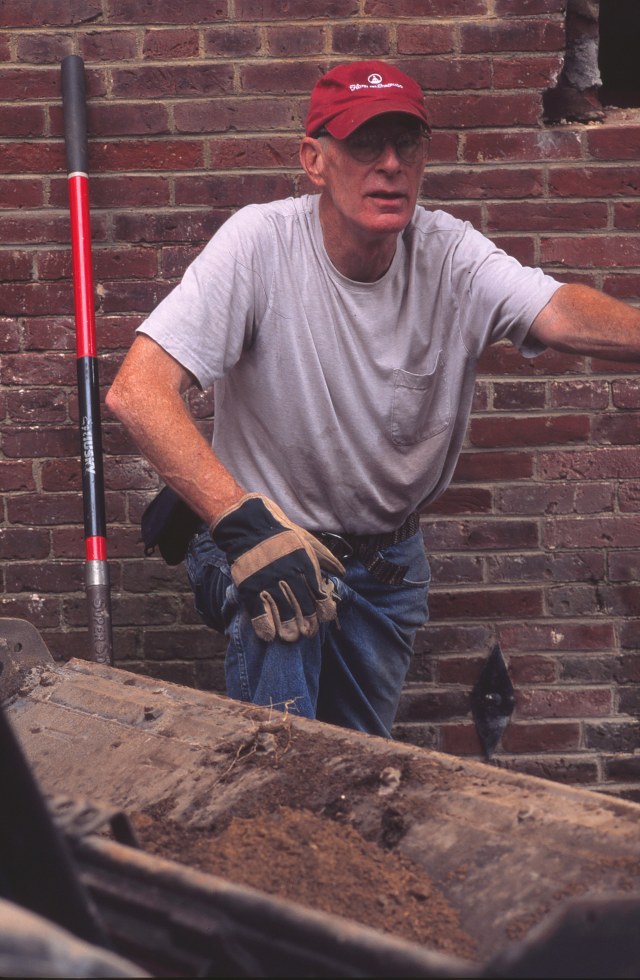
…Well, O’Connor knows who he is. Fred knows who he is. And with the passage of time, Edie and I’ve gotten to know Fred better, and vice versa, with no help from and no need for a little camera in the computer. Rather, we talk face to face, after hours, though Fred can at times seem to work 24/7, Project Manager covering a lot of territory, so to speak, at Historic Harrisville. When it rains- hard– Fred’s out there with his Bobcat, filling in the gullies that the rainwater flowing fast downhill digs into the dirt roads that- still- connect the mill buildings in Historic Harrisville.
Someone has to do it. And do it somehow. So with his own money, Fred bought and maintains the Bobcat. And it’s a big Bobcat- not one of those little garden machines that some guys buy, rather than Harley Davidsons, in retirement to play around on their mini farms.
This thing is a piece of industrial equipment. And Fred once lifted a car- gently- carefully, without damage, from the place its owner continued to block passage on one of those dirt roads- day after day- she’d been asked, requested, then warned it was in the way- and Fred left it on the Historic Harrisville loading dock, just sitting there, like a statue on a plinth…
…until the owner, an otherwise very pleasant young woman- a tenant in one of the old mill buildings- got the message.
That is a good joke, a bit of physical humor for someone whose life has been devoted to maintaining and restoring large things- historic buildings, mostly. -Beginning as a 10 year old kid when the local painting contractor, in Portsmouth, NH, where Fred grew up, asked, “Do you want a job, Kid?”
-And the next morning Fred was working for a paint company, doing stuff the painters weren’t interested in doing. And that led- ultimately- to Fred being the lead painter for the Society for the Preservation of New England Antiquities, now Historic New England- the stewards of some of New England’s finest and most rare historic buildings. And SPNEA- as it was then- sent Fred to MIT for his graduate degree in chemistry (special focus, paint chemistry) so SPNEA would know exactly what was in the 300 year old paint on some of their buildings, and how to replicate it.
So, yes, Fred’s a painter. But not your average painter.
And it’s that highly specialized knowledge, and highly specialized years of experience, that make what he does at Historic Harrisville so special. When it comes to the fabric of the buildings- what was there, how they did it, 150, sometimes almost 200 years ago- depending on the building- Fred knows how to listen to the building.
“And that’s the fun of this job,” Fred tells Edie and me. He’s talking about listening- but when the buildings speak to him, he’s listening in his own way. Sure, he may hear- I don’t know- the voices of the spirits, talking- of the people who’ve worked within these buildings. Because that’s what- at least within the mill buildings themselves- people mostly did, often long hours, and maybe six days a week. Some of the time.
And then some of the time, when the water was running low, and the mill still just water powered- no auxiliary electricity- no doubt they didn’t run at all. No rain- no water running- not enough water running in the little brook becoming a river from the mill pond- and your mill machinery didn’t turn. No cloth got woven.
Now the same buildings hold Harrisville Designs- which makes wooden hand looms and specialty wool yarns to be woven on those looms, and teaches classes in hand weaving- on hand-powered, one person looms- not the mass production of yore- in some of the oldest mill buildings.
…So there are still voices within the buildings. Women- usually women- learning this ancient hand craft. On the kinds of looms that were displaced by the mechanized looms that once filled these mills…
But we were talking about the voices of the buildings themselves, speaking in language of not words, but flaking old paint- and of bricks laid in mortar of one kind rather than another. Bricks laid in mortar of the local sand and not so special lime. -Not the mortar in the Granite Mill walls, that it turns out was imported all the way from Rosendale, New York, and used in the finest granite buildings of the time- 1850s- even by the federal government for its granite forts protecting young America’s harbors.
Who’d have thought? But to listen to that voice- Use this mortar, that’s what I was made of. -Because Rosendale sets in the presence of water, so water- that rushing water that powers this mill- will only strengthen the bonds I make between these huge granite blocks that everything rests upon.
…Listening to that mortar- a natural cement- with a color- almost pinkish- that Fred had never seen before. And sending it for chemical analysis to Chicago, to Great Britain (where they’ve been preserving buildings for 700 years)… just figuring out what was this pinkish, mystery mortar that had held the Granite Mill together, despite all that water, for 150 years.
 Peter Tuttle