It was an old envelope- you could see that- the envelope, though high quality paper, slightly yellowed. And undersized- an undersized envelope, like the kind for cards, note cards, greeting cards. Or courtesy notes.
And this was a courtesy note- from Josephine Hopper, wife of Edward Hopper, the great American 20th century painter. (You remember Nighthawks, the characters sitting at a late night restaurant counter, the dark outside, the windows- just a dim row of an old brick business block outside, across the street).
Yes, that Edward Hopper. That Josephine Hopper- or Jo, as her husband and friends called her- who’d sent this handwritten card, maybe 20 years earlier, to Edie’s grandfather Stow Wengenroth- who was less renowned than Hopper (well, most artists are) but who was highly regarded, and a success in his time- and ours. His limited edition black and white lithographs are still sought after, and the one of the Brooklyn Bridge can cost you…
Well, anyway. This courtesy note from Jo Hopper to Edie’s late grandfather and grandmother- fellow artists, who when the note was written had lived in Greenwich Village, and they visited with the Hoppers, from time to time. Jo- who was not much of a cook- would hold little afternoon teas for friends.
And Stow and his wife, Edith- my Edie’s namesake- had either reciprocated, and Jo was thanking them- or maybe she was following up on a conversation. This was now a long time ago, years after Hopper died, but only shortly after Jo died.
…And so Stow speculated, as we all sat around Stow’s kitchen table- looking at this note mysteriously appearing in the mail, years and years- decades as I recall- after it was written. Had Jo’s executor at the Whitney Museum in New York found the note in Jo’s desk- or fallen behind a radiator- and recognized Stow’s name, and simply sent it on, forwarded it on?
But I mention this all to kind of explain, or convey, what it was like for me- and I’d worshipped Hopper about as long as I was aware of his painting- it did it for me the way no other American painters did- and still does-
I mention this mystery note suddenly appearing in Stow Wengenroth’s mail, years and years after it was mailed- or written and sealed- but eventually sent, after Jo’s death-
Well, maybe it had gotten lost in a Post Office for decades, and when they cleaned out or closed the Post Office…
At the time, it arrived at Stow’s house, in Rockport Massachusetts, where he’d moved, post-Greenwich Village, post-Greenport, Long Island. Edie and I were just married, and I simply had never known, as it gradually dawned on me, anyone who, like Edie, had grown up with art, surrounded by world class art- art painted or printed by her grandfather Gifford Beal, an American Impressionist and also a friend of Hopper’s, and by Stow, the lithographer, and by Edie’s mother, who had been a precocious and very talented watercolorist- made her living with watercolors as a young woman, late 1930s, early 1940s…
Edie’s mother, Telka (Ackley) Beal was so gifted- not to mention her beautiful face- that the young Andrew Wyeth had asked her to marry him.
“But we’d never even held hands!” Telka exclaimed still, some 35 years later, and now a mother of three grown children, including Edie- whom I’d married when Edie and I were 21, 22.
Imagine growing up with an Edward Hopper etching in your grandparents’ upstairs hallway. Nobody mentioned it was there. They were just used to seeing it there… Hopper’s Evening Wind… the nude woman on the bed, the curtains blowing in an open night window…
In my non artist, middle class youth, I had simply never seen a great artist’s work anywhere outside a museum.
And yet there it was. And Beals and Wengenroths.
…The Hopper and the valuable everything else eventually gone, sold as the art appreciated- and so did Edie’s parents’ expenses, living in what had been Gifford Beal’s summer home on Rockport harbor.
But to climb a stairs, and on the landing see Evening Wind…
Well, all of this as prelude. Prelude to explaining why, how, Edie probably had no choice, was destined to herself eventually become a painter. It ran in her family, and the drive to do it, and she was born with that God given talent that really is just a gift. You’ve got it or you don’t. And that’s all there is to it.
Doesn’t mean it ever comes easy. You then have to train it. But the drive and the hand and the eye- either they’re there- or not.
And so, ten years before Edie retired from her corporate job- she worked for General Mills- she began painting every weekend, every vacation. We didn’t go anywhere weekends- well, to St. Paul, maybe. To buy art supplies. But every vacation- and she had a lot- six weeks of vacation by then. We stayed home and Edie painted. Because she knew that when she did retire, she didn’t want to be starting from scratch, given that she’d only have so much time. It’s not as if she was 16 or 26 or even 46.
So that’s what she did, and that’s what she’s done, and that’s why every book I’ve ever published has Edie’s art on the cover.
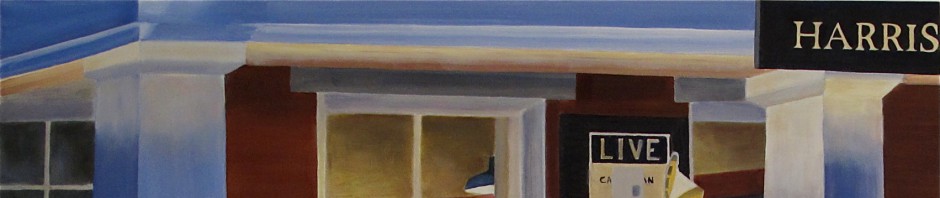
…Including the header of this website- that’s part of her painting of the Harrisville General Store in early evening, the painting titled Sarah at Dusk. And Miriam, the cover art for The Porch of Common Prayer– a portrait of Miriam Sharrock, who put herself through college working at the Harrisville General Store.
Sarah at Dusk
And I’m so proud of Edie- for many, many reasons. But what a pleasure and thrill, now, to walk into a room- almost any room, or into her studio, and see an original Edith Tuttle painting.
More thrilling than seeing that Hopper at the head of her parents’ stairs.
Though not as thrilling as seeing Edie herself- her smile, the light in her hair, the warmth in her eyes, and her warm embrace…
I purchased a letter written by Jo Hopper addressed to “Edith” but didn’t know who Edith was until now. Thank you for posting this, as it now enhances the historical record of Jo Hopper’s letters in the Edward Hopper House Museum archives. Steve Oifer
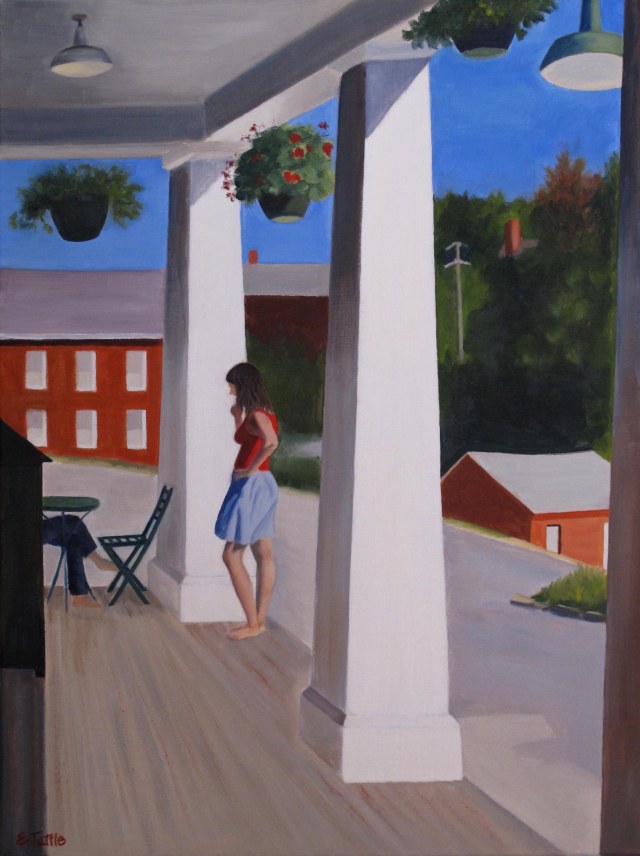 Miriam
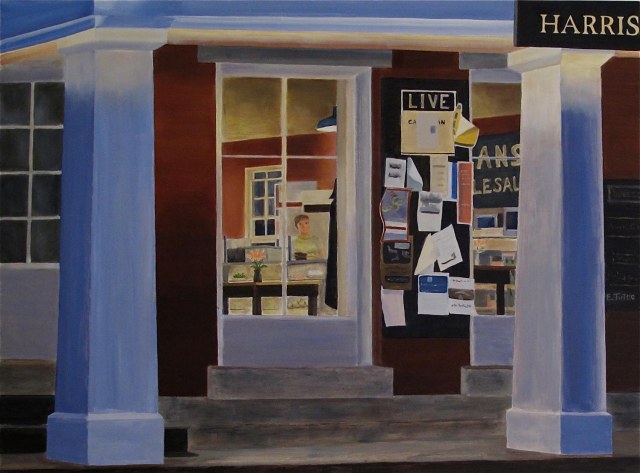 Sarah at Dusk
 Peter Tuttle
I purchased a letter written by Jo Hopper addressed to “Edith” but didn’t know who Edith was until now. Thank you for posting this, as it now enhances the historical record of Jo Hopper’s letters in the Edward Hopper House Museum archives. Steve Oifer
LikeLike