Linda Willett

LindaFilm
         Mostly, Linda Willett wore black. Black not as in the little black dress- I don’t think I ever saw her in a dress- but black as in all business. Black blouses, tailored in an almost Asian, unisex fashion. Linda wasn’t trying to seduce you- or anybody else, especially not the many contractors or government officials she dealt with- with her looks.
         And I doubt that, at any point in her long career in historic preservation in New England, that she ever did.
         That wasn’t the way she worked.
         Nor- so far as I ever noticed, was Linda ever trying to impress you with her power or influence- it was never I’m the important person and you ought to cringeor at least act a little submissive- in dealing with me.
         -Though of course, according to someone who worked with her closely for many years, that did lead to underestimation. Underestimation of Linda’s determination. Her passion to get the job done right. And her willingness to do whatever it took and keep on doing it- to see a job through to the end.
         It wasn’t even that she saw the world, or other people, in black and white- absolutes of goodness and badness- because really, if you want to accomplish anything- working with other people- you pretty much have to take people as they come. Figure out what they’re good at and, if you can, make it possible for them to do their most and their best.
         …And because Linda was so busy doing that, for all the time she was at Historic Harrisville, in its reincarnation and rebirth after she arrived, successively restoring mill building after mill building after mill building after mill building after mill building, to very high historic preservation standards- this isn’t like throwing up a concrete and steel big box in a mall-
         ….and then- and this is part of the job she probably never did have to deal with before- also acting as landlord for what amounted to a small village within a small village- all the small businesses- and the people who owned them, and residential tenants- living in the buildings, working in the buildings, the every day of building repair and maintenance and tenants coming and going and paying rent or not …
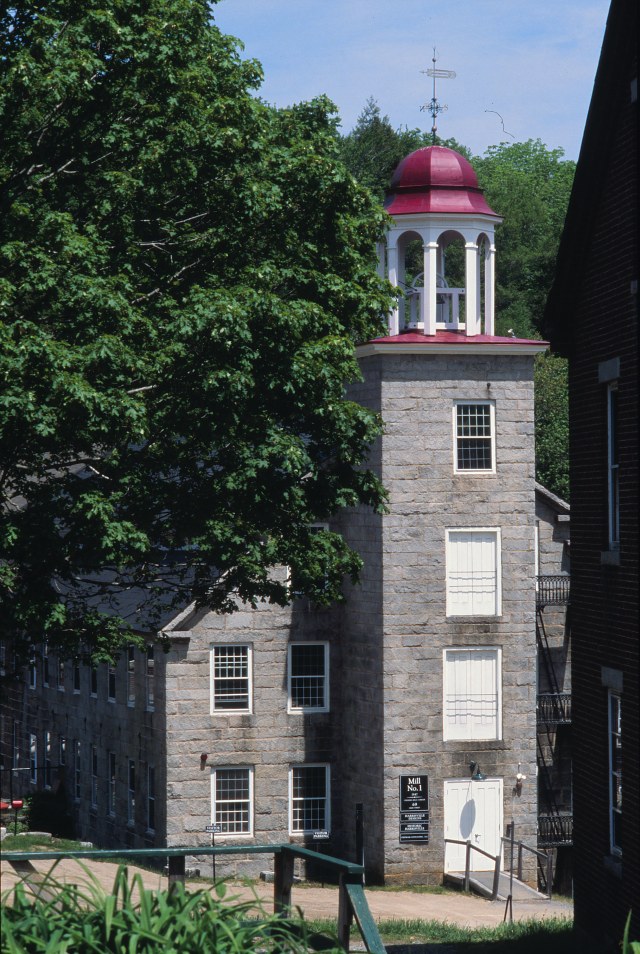
         Linda was always, always busy. Her office door was- right on the first floor of the big, restored Granite Mill- first on the left- her office door was not always open- she didn’t leave it open. But if you opened the door, she was almost always there, and she made time for pretty much anyone and everyone. She was there. And she listened. And if something needed to be done about it, she did it.
GraniteMillFilm

           So. In effect that big green door in the Granite Mill leading to Linda’s office, was at once always closed- she wasn’t there for casual conversation- and yet at the same time- always unlocked, always openable. If you needed to talk to Linda, she was there. There was no screen of subordinates between her and everyone who might need to talk to her. She was it.
         Which was why I rarely spoke- at any length- with her. Edie and I didn’t live in Harrisville. We didn’t rent a studio or office or industrial space from Historic Harrisville. And given the large number of people with whom Linda had to speak, or people who had to speak to her- Edie and I weren’t going to waste her time.
         OK, so I’ve mentioned the people who had to speak to her. But there were also the many, many, many governmental agencies with whom Linda had to speak:
         Very- as it turned out- successfully. In Linda’s 16 year tenure at Historic Harrisville, beginning with the major reconstruction and restoration of the Granite Mill- which is the crown jewel of the village buildings- Linda secured grant after grant after grant for the buildings. -The Lady in Black doing her part to keep Historic Harrisville in the black- in part by her persuasively expert grant applications.
         And have you ever tried to secure a grant to do something with government money? It may be one thing, if you already have a lot of money and a professional lobbyist, and expensively connected friends.
         -Something else again if you come from a village of 1500 people, tucked away in the hills where most people don’t even know it’s there- no major or even semi major- nothing but minor roads pass through the center of Harrisville. It is on the way only to Nelson- a town of 600, so deep in the woods that- well, Edie and I get lost every time we go there. I think of it as Deepest Nelson, the Heart of- not darkness- but Lostness. Which is not to say there aren’t many fine people there.
         But, talking about those grants. You have to make the case for them, and then you have to perform- get done whatever you said you’d get done with the money they give you. And this was where the Lady in Black shone…
           The jobs got done. One by one by one by one, Harrisville, the mill village, arose not from the ashes, but from the sagging roofs, the unpointed brick, the rotted window frames, the buildings with foundations giving way…
         You have only to look at the pictures of Harrisville, the mill village, as it was at the end of its working life as working mills. The Colony family, owner of the mills, and who lived right there in the village- the opposite of absentee owners- had managed to keep those mills going, and the mill workers employed, through years and years- decades, really- of frugal operation and deferred maintenance.
         And then, because the buildings spanned a brook becoming a river- Nubanusit Brook- which supplied the water power that originally drove the mills- that’s why they were there- you were dealing, extensively and endlessly with the state officials who oversaw state waterways. You have no choice, when your mill buildings, built to take advantage of all that water, span that brook, with gates and dams and turbines within- that once turned the mill machinery.
           And Linda somehow- it’s her diligence and determination and expertise, the expertise of dealing with people who have a great deal of authority- whose decisions can make or break your ability to restore those mills… even to restoring a turbine that once powered the Granite Mill… working with the people who make the laws governing every body of water in New Hampshire, and for good reason- we need that water unpolluted and not overflowing its banks- flooding isn’t good where people and buildings live, and we need clean water.
         Linda was the person- really, the only person in Historic Harrisville who made sure, day to day, year to year, that Historic Harrisville took care of those two very different constituencies- the people of the village, and the state and federal officials of the great beyond. -For whom Harrisville was- and is- just a speck on the map.
       And Linda, when not in her office- so people could find her there- or so she could find the people she needed to keep the whole show going- when Linda wasn’t in her office, she was walking, always very purposefully, never fast but never slowly, to see whomever she had to see. Whomever was part of the show.
         She was that Lady in Black- I think she even had a black coat in winter. Always greeted us cordially, but if we had a conversation it usually didn’t last longer than the time it took to pass each other- with possibly the briefest of pauses.
         Not mysterious. Reserved in personality. But not mysterious.
       On the contrary. Linda, for the 16 years she directed the restoration of every one of Historic Harrisville’s buildings, she was the face of Historic Harrisville. And she was always there… from the day she came to work for Historic Harrisville, after a 11 year career with Historic New England, to the day she’d retire, Linda was simply always there.
       Edie and I would have liked to have gotten to know her better. But we didn’t want to take her time.
         But in the beauty and accomplishment of that restored village, and in hiring and renting and maintaining the village she rebuilt… just in the sheer joy Edie and I felt in seeing those buildings reborn, and the pleasure of the people who worked and lived in them- we got to know Linda very well.  -Through that extraordinary restoration work over a decade and a half that she directed…
         …and, from managing leaking faucets to that river running through her buildings…she kept it in the black.
         And then- after 16 years- Linda was done. All the buildings- thanks to Linda- were all restored.
         Lots of people wanted her to stay. More than she knew, the years and passion and expertise and endless care that she’d given Harrisville had woven her into the fabric of the community. And will never leave. But what was done was done. Water over the dam doesn’t flow back again.
           And the Lady in Black, who’d done so much for Historic Harrisville, was gone.
2/
           Well, soon anyway. She’d given her notice.
           But you know how sometimes you- or I, anyway- just don’t want things to end? Not that you don’t know that somehow, some way, they will have to end. Edie and I did not know Linda well- though as I’ve said, we’d have liked to. But she really was just too busy. And she lived a good hour away by car, commuting every day, so that was two hours a day on the road. When she got to Harrisville, she had work to do.
         But what an extraordinary accomplishment. Historic Harrisville had hired her when they got the grant- a two million dollar grant- to restore the Granite Mill- but there were all those other grants that followed that went to restore this extraordinary village.
         -To putting it all back together, while preserving the original and recreating accurately, where necessary, the unsaveable. You don’t buy that expertise from just any contractor. You don’t buy the materials or the skill to do it at Home Depot.
         For someone to, hands on, do some of that work and manage the rest- Linda had hired Fred O’Connor, with whom she’d worked for 7 years at the SPNEA, to be her project manager in Harrisville. Fred had done a lot more than paint at the SPNEA- they’d sent him for that year to Scotland to learn preservation methods used in Great Britain- where preservation had been ongoing for centuries before we Americans got the idea.
       So Fred and Linda made an extraordinary team. Fred knew the physical materials, and having been a contractor himself- his painting company painted more than a million lineal feet of piping at the Portsmouth Navy Yard- Fred also understood the world of contracting. -Something you’d better know, given the range and complexity of work restoring those mills required.
       Well, I could go on and on. Because it went on and on. Building after building restored, so that the village, now in 2015, is truly beautiful. Not a beautiful near-ruin.
         And Fred- late afternoons and evenings- Fred told Edie and me the stories, some of the stories… of how it all happened. After hours, we’d talk with him- usually for hours, at the end of his day. Fred lived on site in the mill complex, so that he was- in effect he never stopped working. He was almost always there. Because he chose to be there.
           Fred once tried to explain what made people who do historical preservation different- because it is different. A relatively small world of very highly skilled people who- because of the nature of their work- can spend a lot of time on the road. The buildings that need work are not all in one place. They are- if you’re working for the Society for the Preservation of New England Antiquities- they’re spread out over all New England.
         And that had been the appeal, part of the appeal, of Harrisville for both Linda and Fred: less travel. They’d spent- they’d both spent a decade travelling all over New England. And for Fred especially, that meant living- sometimes for long periods of time- away from home, but at the job site, for as long as those jobs lasted. And Linda, too, spent a lot of time on the road- going to those same properties- and all the others the SPNEA owned- hundreds of them.
         While Harrisville: one place. For Linda to commute.  For Fred to live. And an entire village that needed restoration. That deserved restoration. The village was not just a complete rural New England mill village- it was beautiful. And the Colony family, owners of the mills (and much else) in Harrisville, and the Putnam family, industrialists in the nearby city of Keene- were themselves dedicated to historic preservation. They had founded Historic Harrisville.
         So all the elements were there. It was better- in a way- than Historic Williamsburg, Virginia- which, though much bigger, is a recreation. These Harrisville buildings were the original buildings. Not much changed from their working days.  -Because they hadn’t needed to be changed. Until very recently, they’d been doing the same things they were built originally to do.
         So Harrisville was an extraordinary possibility… and if you have a passion for historic preservation- and it does require a passion- no one does it just because it’s a job. If you have the skills to do preservation- you could get paid a lot more to do a lot simpler work in the commercial world…
       So there they were. These two people, Fred and Linda, who from so many years working together trusted and admired each other. -Different though they were in personalities and skill- their skills were complementary.
         And there Edie and I were, having wandered into Harrisville and become friends with Fred, and also having learned- without trying- something about the chemistry between Fred and Linda that made it all possible- the restoration of that village.
         And now, in late 2015, it was almost over. The buildings were restored. Ready or not, Harrisville was headed for a new, post-Linda era.
         I couldn’t imagine Fred staying around forever afterward. The chemistry, the shared passion for restoration, the long partnership in dedication…
        Just with Linda gone, whatever Fred did in her absence- in some way it was over.
3/
         You knew the Fred and Linda era couldn’t last forever. But it was also true- because they’d become woven into the threads of the village, the threads of the lives of the people in the village- that there were many, many people who didn’t want to see them go. Didn’t want the restoration era to be over.
         Edie and I certainly didn’t want that era to be over. Though- rationally- we had known that- in one way or another- we’d understood that it would end, at least for Fred and Linda. Fred already in his early 60s, Linda in her mid 60s. As Edie and I were.
           And time, if nothing else, does catch up with you…
       …ever try lifting out and then descending a ladder with a 200 pound, 19th century window that needs rebuilding?
         You can go on doing these things. But at some point- your knees, or your back- your something- just isn’t happy.
         So sure, Edie and I didn’t want to see any of it end. That had been Harrisville as we had come to know it and, really, love it. That shared passion for preservation, restoration- that beautiful way that someone’s passion for life expressed itself in some people. Not all people. But some people…
       …for, in the end, the pleasure and well being of anyone near, anyone living in or anyone working in those buildings….
           …all that water, all that River of Life…
                         water over the dam.
© Peter Tuttle, text and photos. All rights reserved.
This entry was posted in Local Heroes and tagged , , , . Bookmark the permalink.

Leave a comment